+44 1339 336159
 info@onlinepatches.co.uk

Customizing patches becomes easy when one works with an online manufacturer offering various materials, designs, sizes, and backings. Knowledge about how to make custom patches online allows people and companies, as well as sports teams and organizations, to choose the appropriate design, artwork, specifications, and approve proofs before proceeding to production.
Patches have a variety of uses, including clothing items, uniforms, accessories, and promotional items, among others, and choosing the right manufacturing process is important. When one is looking for information about how to make custom embroidered patches online? Then one should know about embroidery processes and other related information.
How Do You Make Custom Patches Online?
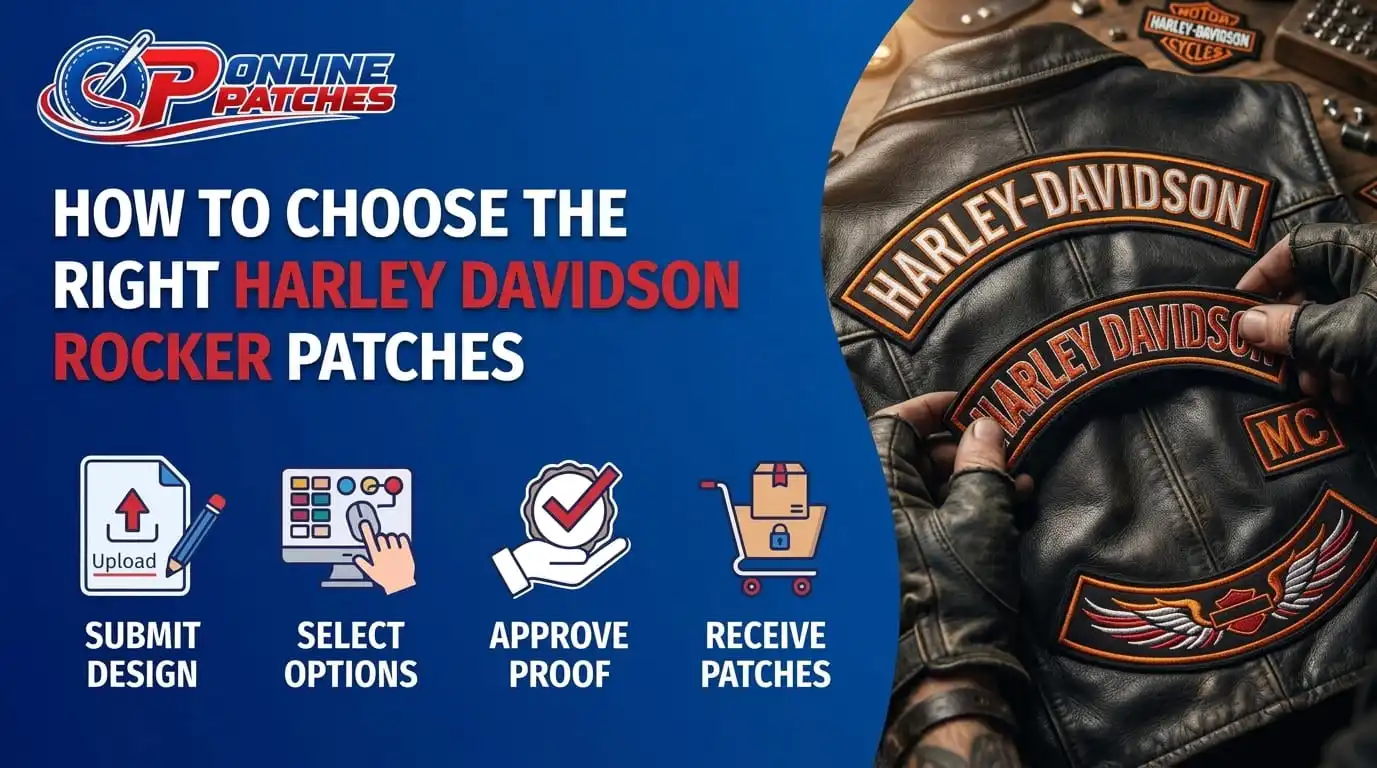
When ordering custom-made patches through a web page, one has to select a patch style, upload the artwork, set specifications, and finally approve the digital proof. Most professional manufacturers offer such services via their web pages, enabling the customer to place orders from home without having to go to the manufacturing plant. Understanding how to get custom patches made online will assist in selecting a suitable patch style and customizing your design.
Choose the Right Patch Type for Your Design
First, determine what purpose your patch is intended for. Embroidery would be perfect for traditional style patches and uniform patches, while weaving and printing would be best for designs with a lot of detail.
Think about the intended use of the patch, its frequency of use, and whether it needs to be able to endure repeated washing or outdoor elements.
Upload Your Logo, Artwork or Custom Design
Prepare a clear digital version of your logo, illustration, text, or other artwork. High-resolution files help manufacturers understand the design and reproduce its details accurately.
Commonly accepted formats include PNG, JPG, PDF, AI, and EPS, although requirements vary between suppliers. If your artwork needs adjustments, ask whether the manufacturer offers design assistance.
Select the Size, Shape, Colours and Backing
Choose dimensions that make the design readable and suitable for its intended placement. Popular shapes include circles, rectangles, squares, shields, and custom outlines.
Choosing the right colors and backing material is essential as well. Some typical choices are iron-on, sew-on, adhesive, and hook-and-loop backing. Each has its own advantages in attaching the patch.
Review Your Design Before Placing an Order
A digital proof gives you an opportunity to see the design even before the manufacturing process begins. Inspect your spelling, colors, proportions, dimensions, borders, and positions of individual elements.
Ask for corrections in case your preview does not match your initial instructions. Approving your final proof without taking care of these issues may lead to mistakes in the manufacturing process.
Where Can You Have Custom Patches Made in the UK?
Customers searching for where to have custom patches made? can explore specialist manufacturers that provide online ordering and delivery across the United Kingdom. Comparing suppliers is important because production methods, material quality, customer support, and delivery arrangements can vary.
Choosing a Reliable Custom Patch Manufacturer
An established company would also give details on their manufacturing process, possible materials and personalisation services. Some of the details that manufacturers should have include:
Types of patches that they manufacture and the process used.
Minimum quantity for ordering.
Methods of artwork submission and digital proofing.
Options for backing, borders and finishing.
Scheduling for production and delivery.
Also, samples from previous orders may help you ascertain whether they have manufactured a similar design to the one you want.
What to Look for When Comparing Patch Suppliers
Do not compare suppliers on price alone. Examine the quality of their previous work, clarity of specifications, communication, and ordering process.
Customer reviews can provide additional insight into product consistency, order accuracy, and delivery experiences. For larger projects, requesting a sample may help you evaluate materials and finishing quality before committing to a complete order.
Why Ordering Custom Made Patches Online Is Convenient
Online ordering enables customers to browse various materials, styles, and specifications without needing to come to the actual production site. Online ordering also facilitates artwork submission, discussions about requirements, and viewing digital proofs.
Businesses and organisations can use online patches services in the UK to organise orders for employees, promotional campaigns, sports teams, and other group requirements.
How to Make Custom Embroidered Patches Online
Embroidery is a popular manufacturing technique because it creates a textured appearance through coloured stitching. Understanding its characteristics helps customers choose artwork that can be reproduced effectively.
What Makes Embroidered Patches Different?
Embroidered patches are made by sewing colored threads into a fabric material. The embossed nature gives it the traditional look, which suits jackets, uniforms, caps, bags, and other items.
Coverage of the embroidered patches impacts the final look. High coverage will make it appear more filled, while low coverage leaves some of the fabric visible.
Choosing Thread Colours and Embroidery Coverage
Select thread colours that provide sufficient contrast and preserve the recognisability of the original artwork. Avoid using several similar shades in small designs because individual details may become difficult to distinguish.
Embroidery coverage refers to the proportion of the patch surface filled with stitching. The appropriate level depends on the design, desired texture, and production requirements.
Which Designs Work Best for Embroidered Patches?
Use of bold font, illustrations, recognizable brands or logos, and large symbols is usually recommended when designing embroidered items.
Small text, gradients, and photographs may not be applicable in embroidery and can necessitate other production methods. Eliminating unnecessary details helps to increase clarity and improve design.
How to Make Custom Iron-On Patches Online
Iron-on patches provide a convenient attachment method for many clothing and fabric applications. They contain a heat-activated adhesive layer that bonds the patch to a compatible surface when applied according to the manufacturer's instructions.
How Does Iron-On Patch Backing Work?
The iron-on backing contains an adhesive that is activated by heat and pressure. When used properly, the patch is then attached to the fabric.
Customers researching how to make custom iron on patches online? should check the manufacturer's application instructions, including recommended temperature, pressing time, and fabric compatibility.
Are Iron-On Patches Suitable for Every Fabric?
No. Some materials cannot tolerate the heat required for adhesive activation. Delicate fabrics, certain synthetic materials, and heat-sensitive garments may become damaged during application.
Before you put on your patch, always remember to read the care label of your clothing first.
When Should You Choose Sew-On or Iron-On Backing?
The appropriate backing is dictated by the kind of fabric, purpose, and use.
In the case of washing or using a garment frequently, sewing may give extra attachment strength.
Can You Make Custom Patches at Home?
Indeed, it is possible to make things at home with simple craft supplies, materials, adhesive, and sewing supplies. But homemade production is likely to require a lot more manual work compared to industrial production.
Materials and Equipment You Need
Basic supplies may include fabric, scissors, embroidery thread, needles, backing material, fabric markers, and an iron if you are using suitable heat-activated adhesive.
More advanced projects may require an embroidery machine, transfer paper, or specialised printing equipment.
A Simple Step-by-Step Guide to Making Patches at Home
If you wish to learn about how to make custom patches at home?, then here are some basic steps to follow:
Draw or print your design on paper.
Choose an appropriate fabric base.
Transfer your design on the fabric.
Embroider or stitch on it as per the need.
Cut your patch as per requirement.
Trim and finish the edges in order to avoid any unraveling.
Fix appropriate backing as per the requirements of the patch.
Give time for finishing and ensure that your patch is durable enough for its purpose.
DIY Patches vs Professionally Made Custom Patches
Home production is useful for personal crafts, small experiments, and simple designs. Professional manufacturing is generally more appropriate when consistent sizing, detailed artwork, larger quantities, or commercial presentation is required.
What Types of Custom Made Patches Can You Order?
Diverse production processes result in varying aesthetics and advantages. Awareness of their distinctive features aids consumers in making the right choice. Companies could also consider custom made patches for branding, staff identification, uniforms, and marketing purposes.
Embroidered Patches
Embroidered patches feature stitched designs with a raised texture. They are commonly used for school uniforms, sports clubs, workwear, and branded clothing.
Woven Patches
Weaving patches involve fine threads being used to weave in order to reproduce finer details. Woven patches are helpful in designs that require a smooth finish and details that are not achievable through embroidery.
Printed Patches
Printed options reproduce artwork directly onto a suitable material. They are particularly useful for detailed illustrations, multiple colours, and designs containing gradients.
PVC and Other Speciality Patches
PVC patches are manufactured using flexible synthetic material and can feature raised or recessed details. They are often selected for outdoor equipment, tactical accessories, and products requiring a distinctive appearance.
How Do You Get Patches Made Online Without Making Common Mistakes?
An order is not only about selecting an aesthetically pleasing design. It also includes preparation of artwork, correct measurements, right backing, and approving the proofs.
Use High-Quality Artwork and Readable Text
Provide artwork which is easily understandable and has high resolution. Avoid having very complex art work, particularly when the artwork involves small letters or thin lines.
In case of embroidered and woven products, consult the manufacturer about whether any changes are required in the artwork.
Choose the Correct Patch Size and Backing
Consider the available space on the garment or accessory before finalising dimensions. A patch that is too small may make its text difficult to read, while an oversized design may look unsuitable.
Choose backing according to the material, attachment requirements, and intended application.
Check Your Digital Proof Before Production
Rather than just focusing on the logo, examine the entire design. Look at the spelling, color placement, borders, shape, and proportions.
Make sure that the approved proof reflects what you have asked for. This step is especially important for bigger orders, as corrections may be harder to make once production starts.
Are Printed Patches Online a Good Choice for Detailed Designs?
Printing patches is a great way out when the art work in question has certain features that are hard to stitch. The printing process makes it possible for the design to have more elements.
When Should You Choose Printed Patches?
Consider printed options when your design includes photographs, complex illustrations, multiple colour transitions, or small visual details.
Businesses and creative organisations often prefer this method for promotional artwork that needs to retain its original appearance.
How Printed Patches Capture Small Details and Colour Gradients
As opposed to traditional embroidery, printing does not rely on recreating all images through sewing individual stitches. This allows for more detailed artwork and smoother color gradients.
Nevertheless, the end result is still determined by the quality of the printer, materials used, and manufacturing process.
When to Consider Printed Patches Online for Your Project
Custom printed patches are worth considering when design accuracy and colour reproduction are more important than a raised, textured finish. Compare available materials and finishing options before choosing a production method.
How Much Do Custom Made Patches Online Cost?
The cost of custom made patches online varies according to design complexity, material, dimensions, backing, quantity, and production requirements. There is no single price that applies to every order.
Factors That Affect Custom Patch Pricing
The major considerations for pricing are:
Size of the patch and dimensions.
Embroidering, weaving, printing or PVC work.
Colours and design intricacy.
Choice of border and backing.
Amount ordered and manufacturing considerations.
Shipping and other additional services.
Please ask for a detailed quote.
Does Ordering in Bulk Reduce the Cost?
Most companies provide cheaper unit cost for larger orders because it is possible to spread out the cost of manufacturing among more units.
Nonetheless, different firms have different conditions such as minimum order amount and discounts offered. Take into account the order cost in relation to the unit cost.
Final Thoughts: What's the Best Way to Get Custom Patches Made?
Which approach works better? It all comes down to your design, its purpose, material preference, and number of orders. First, choose an appropriate manufacturing method, create proper artwork, ensure that the backing and size requirements are right, and check out the digital proof carefully.
If you want to get patches made online, you need to work with a specialist company that will simplify the task for you and offer various options for materials, shape, and finishes. Comparison of suppliers and specification of all the details before ordering is highly recommended.
Understanding how to get custom patches made online also helps you evaluate manufacturing methods, communicate your requirements, and select a supplier that meets your expectations. Whether you need patches made online for a personal project or a larger commercial batch, careful planning can improve the overall ordering experience. You can also make custom patches by selecting the right materials and following a suitable production process.
Frequently Asked Questions About Custom Made Patches
1. How to Get Custom Patches?
To understand how to get custom patches?, start by selecting a suitable patch type, preparing your artwork, choosing dimensions and backing, and submitting your requirements to a specialist manufacturer. Review the digital proof before approving production.
2. How Long Does It Take to Get Custom Patches Made?
The production time will depend upon the producer, size of the order, design complications, and production schedule. The delivery time must also be taken into consideration while making the total time estimate for the order.
3. What File Format Should I Use for Patch Artwork?
Common formats include PNG, JPG, PDF, AI, and EPS. Vector formats are often useful for maintaining clean artwork, but accepted file types vary between manufacturers.
4. Can I Order a Single Patch Online?
Some suppliers take in individual orders, while others demand minimum quantity orders. Before you place your order, ensure that you understand the supplier’s policy regarding orders.
5. Are Custom Patches Washable?
Many professionally manufactured patches are suitable for regular garment use, but durability depends on the material, backing, attachment method, and care instructions. Follow the manufacturer's washing recommendations.
6. Which Patch Type Is Best for Detailed Logos?
Woven and printed fabrics are usually ideal for complicated designs and small text. It all depends on how complex the design is and its intended application.
7. Can I Customise the Shape and Size of My Patches?
Yes. There are many manufacturers who have shapes that are standard and custom along with varying sizes. Check the possibilities of what is available to you.